Northern Utah vs. Southern Utah: Which Is Right for You?
Utah's two halves offer genuinely different lives, and both are incredible. One is not objectively better than the other; this really is a weather and lifestyle choice more than anything else. Here is the honest breakdown of what changes when you pick the north versus the south.
What's in this guide
Climate and Weather
This is the biggest difference between the two halves, and it affects your whole year. Northern Utah runs on four distinct seasons. Winters bring real snow and legitimately cold stretches, which is exactly what makes some of the best skiing in the country possible. Springs are green and changeable, summers are warm and dry with cool canyon escapes nearby, and autumns deliver the state's famous gold and orange show. The trade-off is winter inversion, when cold air can trap haze in the Salt Lake Valley for stretches at a time.
Southern Utah is high-desert country with a completely different rhythm. Winters are mild, with sunny days that keep outdoor life comfortable year-round, and even the occasional dusting of snow in a place like St. George melts fast. Summers are the flip side: July and August bring serious heat, often well above 100 degrees in the low-elevation red rock towns. Locals adjust by doing outdoor activities early in the morning, and the region's reservoirs and canyons become the afternoon escape.
So the weather question is a real one: snowy winters and green summers versus mild winters and scorching summers. If you hate scraping ice off the car, that alone might decide it. If you live for powder days, the south will feel like the wrong coast.
Landscape and Recreation
Northern Utah's backyard is the Wasatch and Uinta ranges: alpine lakes, river canyons, and ski resorts that range from world-class resorts to quiet local hills. A Salt Lake City resident can be on a chairlift in about half an hour, and the summer scene is all about high-country hiking, mountain biking, fishing, and river floats. The valleys themselves are green and irrigated, ringed by dramatic mountains in every direction.
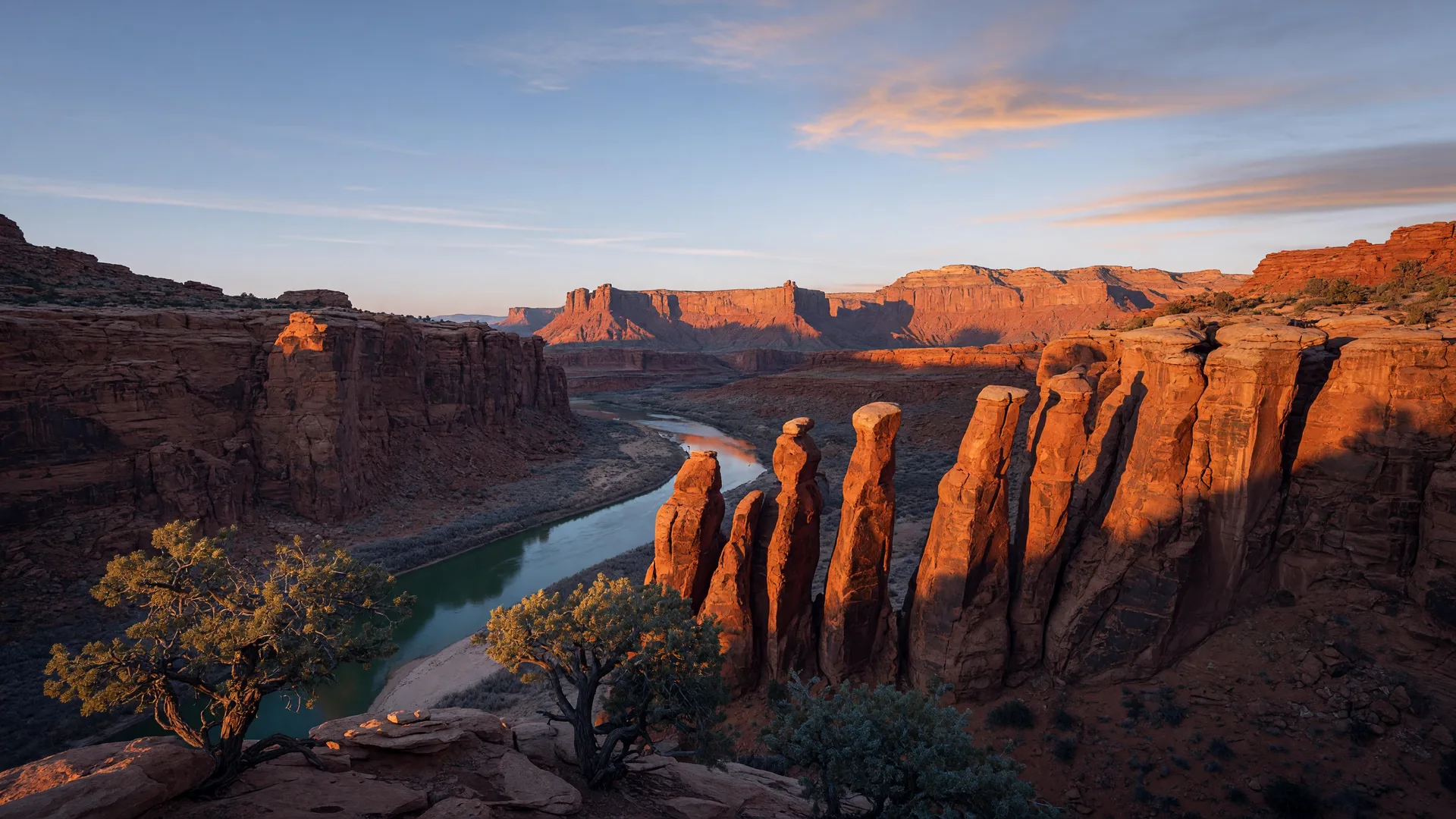
Southern Utah is a different planet geologically, and for many people that is the whole point. The region anchors the top of the state's five national parks: Zion, Bryce Canyon, Arches, Canyonlands, and Capitol Reef are all within a day's drive, and Zion and Bryce are practically in the neighborhood for St. George and Cedar City. The scenery is red rock on an epic scale, sculpted canyons and slickrock domes, and the trail network is endless. St. George in particular has become a snowbird haven and a base camp for anyone who wants world-class desert recreation on their doorstep.
Neither half disappoints; they just reward different hobbies. Skiers, alpine hikers, and lake fishermen lean north. Canyon hikers, trail runners, and year-round golfers lean south, where the trails stay mostly ice-free through winter.
Jobs and the Economy
If your move is driven by a job or a career, northern Utah is where the density is. The Wasatch Front, anchored by the Salt Lake City metro, holds the state's government, healthcare, finance, media, and the Silicon Slopes tech corridor that runs south through Utah County. Commuting between the two counties is covered in our Salt Lake County vs. Utah County guide; the short version is that the north is the jobs engine of the state.
Southern Utah's economy is smaller but growing fast, and Washington County around St. George has been expanding for years. Healthcare is a reliable anchor, with a growing regional hospital system serving both residents and the retiree influx. Construction and trades are booming with the pace of new development, tourism supports a large slice of local employment, and a steady wave of remote workers has followed the lifestyle south. It is an economy on the rise, just with less density and fewer headquarters than the north.
Distance matters more than either region's residents like to admit. Utah is a big state, and the drive between Salt Lake City and St. George is a full day-trip on its own, roughly four hours of highway through some of the most dramatic scenery in the West. Family in the other region means planning visits, not dropping in. Most people make this choice knowing that whichever half they pick becomes their real home base, with the other half as the vacation and holiday destination rather than the everyday one.
Honest advice:
Landed a remote role or a transfer? The south becomes dramatically more viable. Searching for a job in a narrow field? The north probably has your industry, and the south will be a longer look.
Cost of Living and Housing
In relative terms, northern Utah's hottest ZIP codes carry some of the highest prices in the state, especially along the Salt Lake County bench and in resort-adjacent areas. But the north also has more range: older suburbs, smaller towns off the interstate, and starter neighborhoods that keep a wide spread of price points available.
Southern Utah had a genuine affordability advantage for a long time, and it still holds one compared to the priciest Wasatch Front neighborhoods. But St. George and Washington County have grown so quickly that prices have climbed year after year, and the gap keeps narrowing. New construction is abundant, which helps, and homes in the region tend to be newer on average than the aging housing stock in some northern neighborhoods.
The honest summary is that this comparison changes quickly. A price that held in either region a year ago may already be history. Utilities and everyday costs are broadly comparable between the halves, with air conditioning doing more work in the south during summer and heating doing more work in the north during winter. If your budget is the deciding vote, the sensible step is to compare specific towns in the same week rather than rely on a memory of either region's prices.
Lifestyle and Pace of Life
Northern Utah is where the state's big-city life happens. Professional sports, a busy arts and music calendar, an international airport, dense career networks, and the fast-growing tech scene all live along the Wasatch Front. It can feel like a small metro with big-metro ambitions, and the pace matches it: full freeways, school rush, and a calendar that fills up fast.
Southern Utah trades much of that for a slower, outdoors-first rhythm. St. George's downtown has grown into a genuinely lively dining and events scene, but the culture is still defined by the desert: early-morning trail runs, year-round golf, farmers markets, and weekends spent at reservoirs or in the canyons. It is a strong draw for retirees and for families who want recreation to be the centerpiece of the week, and it is increasingly popular with remote workers who bring big-city paychecks to small-town pace.
The honest framing is that the north offers more of everything except space and sun. If you want career density, cultural amenities, and four genuine seasons, the north delivers. If you want warm winters, wide-open scenery, and a calendar built around the outdoors, the south is increasingly hard to beat.
Quick Answers: Northern Utah vs. Southern Utah FAQ
Is it hotter in Southern Utah?
Yes, significantly, especially in July and August, when low-elevation desert towns regularly see temperatures well above 100 degrees. Northern Utah summers are warm and dry but rarely extreme. The south's reward is mild winters; the north's reward is cooler summers and real seasons.
Does it snow in St. George?
Occasionally, but it is rare and melts quickly. A modest dusting every few winters makes the news; meaningful accumulation is not part of normal life there. The surrounding high country, Brian Head resort above Cedar City included, gets plenty of snow and is a short drive away.
Where are the jobs?
Northern Utah has the density: government, healthcare, finance, tech along the Wasatch Front. Southern Utah is growing fast in healthcare, construction, tourism, and remote-work jobs, but it is a smaller market with fewer employers in specialized fields.
Which is better for retirees?
For most retirees, southern Utah is the draw: mild winters, active adult communities, golf, pickleball, and year-round trail access. St. George has grown into one of the West's most popular retirement destinations. Northern Utah is a fine option for retirees who want to stay close to family or big-city healthcare and arts.
Which half is best for outdoor lovers?
It depends on your sport. Skiers and alpine hikers should pick the north. Canyon hikers, trail runners, and golfers should pick the south. The enthusiast answer is that Utah rewards living in one and road-tripping to the other, because both are spectacular.
Not sure which half of Utah fits you?
Utah's communities welcome everyone, and the best fit is about what works for you and your routine. If you are weighing northern versus southern Utah, reach out with your priorities and I will give you a straight answer, no sales pitch attached.
Reach Out