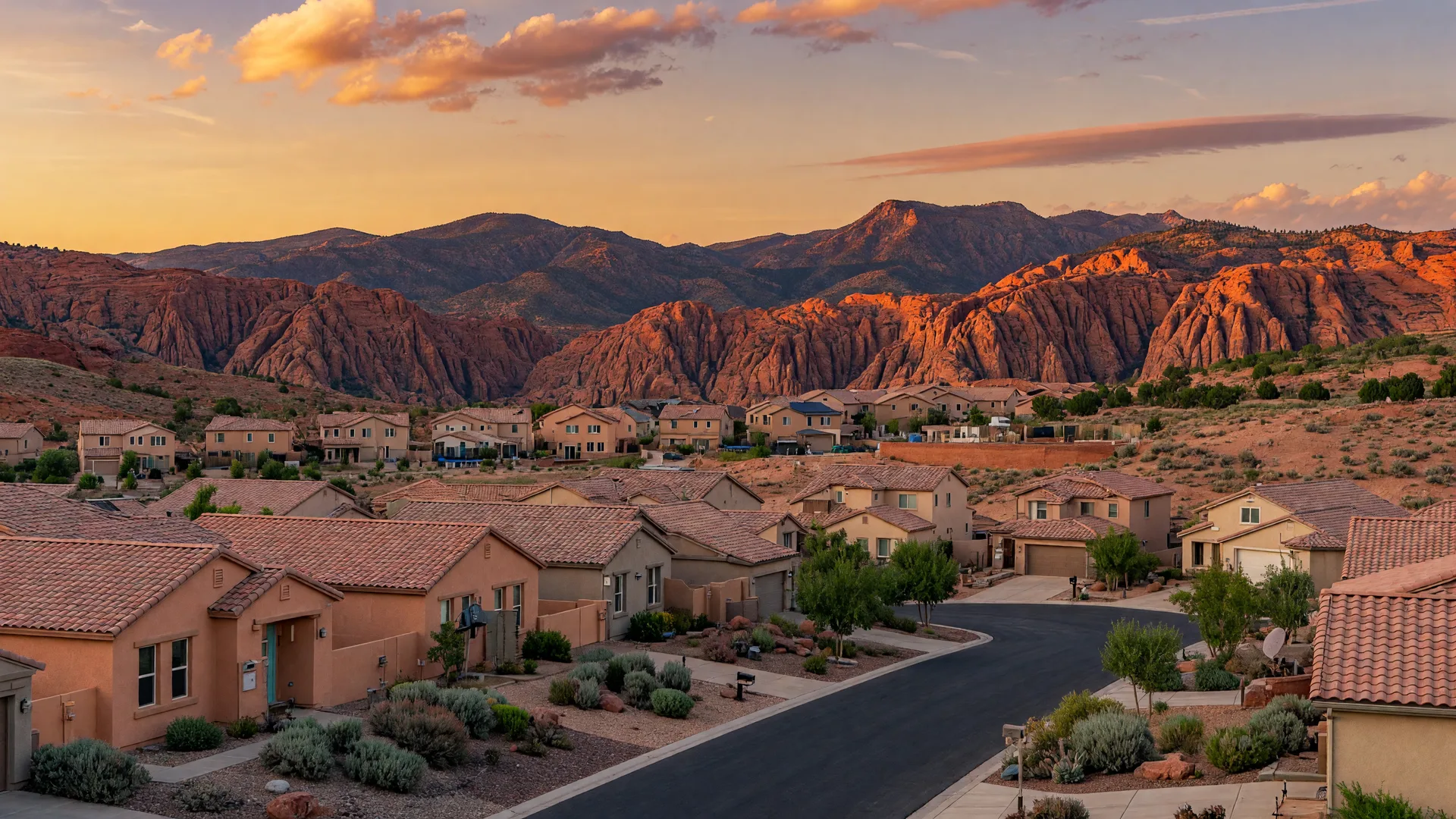
Washington
Utah's second-fastest-growing city, straddling St. George and Snow Canyon with red rock views, brand-new master-planned communities, and everything the region offers about 10 minutes away.
Overview & Character
Washington City is the engine of Washington County's boom: one of the fastest-growing cities in Utah, and often counted among the fastest-growing small cities in the entire country. It sits on the northeast edge of the St. George metro, between the region's hub and the red rock scenery of Snow Canyon, and its identity is built on that in-between spot.
Where St. George feels like a small city, Washington feels like a collection of newer neighborhoods on a grand stage. Master-planned communities spread across the benches with red rock views in every direction, newer retail follows the growth, and the pace of building is honestly astonishing. It is not a historic town, it is a here-now town, and that is exactly what draws many people.
The character is friendly and practical. Neighbors tend to be fellow transplants, everyone is here for the same reasons, sunshine, scenery, and a more manageable cost of living, and the result is a community that welcomes newcomers instead of merely tolerating them.
What Newcomers Should Know
Washington grows so fast that the honest answer to "what is it really like" changes every couple of years. Here is what is true today:
Lifestyle
Daily life in Washington is neighborhood-centered. Communities have their own parks, trails, clubhouses, and pickleball courts, and a lot of life happens within a half-mile of home. The growing dining and retail scene along the Red Cliffs corridor means date-night options keep multiplying without a trip into St. George, while the biggest stores, the regional hospital, and the airport all sit just minutes away.
Demographically the city is a blend of young families and active retirees, and the two groups share the same amenities happily. Weekends default to the outdoors: a morning hike in Snow Canyon, an afternoon on the water at Sand Hollow, or an evening show at Tuacahn. The pace is slower than the Wasatch Front, the light is softer, and the mountains are red.
Recreation & Things to Do
This part of Utah is one giant playground, and Washington sits at the center of it. A few local favorites:
The pickleball scene deserves its own mention: courts are everywhere in the new communities, leagues fill up fast, and lessons run through Pickle Up Academy.
Weather & Climate
Welcome to high-desert weather at the Mojave's northern edge: mild, sunny winters and hot, dry summers. Washington County winters are genuinely pleasant, with daytime highs often in the 50s and 60s, and snow a rare event that melts by afternoon. That is why the snowbirds come.
Summer is the trade. July and August days regularly top 100 degrees, so outdoor plans happen early and late. Low humidity keeps the heat bearable, and cooling evenings and an aggressive schedule of pool, lake, and canyon time make it workable. At about 2,900 feet of elevation, Washington runs a touch cooler on summer nights than St. George proper, which the locals notice.
Rain is scarce, so the desert palette of red rock, sage, and evergreen juniper defines the view, and the region's 300-plus days of sunshine mean you will actually use that patio.
Cost of Living
Compared with the Wasatch Front, Washington is still a value: housing runs a meaningful step below comparable new construction in Salt Lake, Utah, or Davis counties, and everyday costs track close to the regional norm. Within southern Utah, Washington generally prices a little under St. George's premium addresses while offering the newer inventory that many buyers prefer.
The caveat is momentum: prices have climbed steadily with demand, so today's "deal" is tomorrow's "average." Utilities run a bit above the national average thanks to summer air conditioning, groceries are close to normal, and the no-tax-on-Social-Security rule makes the whole region magnetic for retirees.
Schools & Education
Washington is served by the Washington County School District, which has built schools as fast as the county has grown and generally keeps pace well. Newer campuses, modest class sizes, and strong community support are the norm, and parents should confirm their exact assigned school when house hunting, since boundaries shift as the district adds campuses.
For higher education, Utah Tech University in nearby St. George anchors the region, with a growing campus and programs that serve the county's booming population. Charter options exist around the metro for families who want them.
Commute & Practicalities
Washington is a car town, and that is fine, because the distances are short. St. George's downtown, regional hospital, and Utah Tech campus are roughly 10 minutes away, the St. George Regional Airport is a quick drive up the corridor, and I-15 links you north to Cedar City or south to Las Vegas.
The honest note: the road network is growing with the city, and the main corridors get busy at peak hours in a way that surprises people who moved here for small-town calm. Give yourself a few extra minutes morning and evening, and expect new roads and underpasses to keep appearing as the county builds out.
Practicalities to know: summer is low-humidity but genuinely hot, so plan landscaping for water efficiency, shade for the patio, and an efficient air conditioning system. The sun is intense year-round, and the views never stop paying you back for it.
Pros & Cons
Pros
- One of the fastest-growing cities in Utah
- Snow Canyon State Park at the doorstep
- Newer, master-planned housing inventory
- 10 minutes from all of St. George's amenities
- Growing dining and retail along the Red Cliffs corridor
- Terrific base for exploring southern Utah
Cons
- Summers get genuinely hot
- Traffic on the access corridors is building fast
- Character still feels brand new in many areas
- Water and infrastructure keep pace with growth, not ahead of it
- You will drive to St. George for the biggest services
Who Is Washington Best For?
Moving to Washington: Common Questions
Straight answers to what newcomers ask most.